Dear visitors, musicians, and guests,
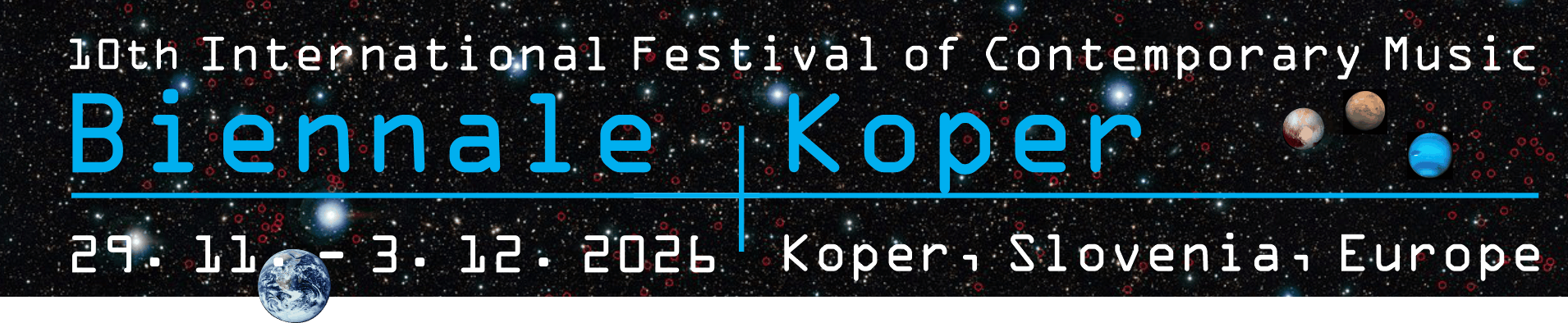
welcome to the 10th Koper Biennale, the international festival of contemporary music. Those of you who have followed us from the very beginning likely know that each edition features its own theme. This year, we chose planets and outer space… Sphaera mundi—the ancient idea that the universe is one grand symphony, with humanity as both a listener and an instrument within it. All dimensions of the cosmos will guide us in exploring different worlds, searching for the meaning of music, reviving ancient connections between reality and mythology, and rekindling lost dreams that once placed humanity at the center. We live in a time when the bond between nature—or the cosmos—and humanity has been severed. It is becoming increasingly difficult for people to connect with themselves or even to feel at all. The pursuit of material comfort suffocates that primary quest to discover and accept oneself as a unique being connected to "all things on Earth." The greatest wisdom has always arisen from observing nature and exploring our own emotions. We ourselves are an unexplored universe, and I believe the true purpose of life is to recognize our authentic essence. Sometimes, we only appreciate the value of something once we have lost it. Therefore, we embark on a journey through different worlds, planets, and musical works, hoping our voyage ends with the realization that we already have our own world, our own planet… our own Earth. We must learn to cherish it, as it is our only home, which we are duty-bound to hand over unharmed to future generations. We must learn to love. So, we begin on Earth, catch a glimpse of our satellite, the Moon, and journey past the other planets. I hope each of you finds a piece of yourself here—and, above all, discovers what Dante found on his journey in the Divine Comedy: "L'amor che move il sole e l'altre stelle" / "The love that moves the sun and the other stars" (Paradiso, Canto XXXIII, v. 145).
Tatjana Jercog
If there is a profound connection between music and the universe, perhaps it lies in the human desire to explore what we do not yet know. Since antiquity, by observing the movements of celestial bodies, humanity has sought to discern an order in the cosmos, a system of proportions and relationships that finds one of its most fascinating expressions in music. In the Somnium Scipionis (Dream of Scipio), Cicero writes: ‘Nec enim silentio tanti motus incitari possunt’ — ‘For movements of such magnitude cannot take place in silence.’ It is one of antiquity’s most evocative images: the universe as an immense architecture of sound, in which every celestial body contributes to a harmony that the human ear cannot perceive. Yet the universe is not merely order and harmony. It is also transformation, instability, energy, and ceaseless motion. Perhaps the music of our time, with its inexhaustible capacity to reinvent the language of sound, can offer us a new perspective on this complexity.
During the twentieth century, as humanity prepared to venture beyond the boundaries of Earth, music too embarked on a journey into unexplored territories. Timbre, noise, space, and silence became new dimensions of composition. The advent of electronics expanded these horizons still further, allowing sound to break free from the traditional boundaries of instruments and move through space, until the surrounding environment itself became part of the musical experience. In the cosmic visions of Karlheinz Stockhausen, for example, the universe was not simply a source of inspiration, but a model for imagining new ways of organising sound and time.
Celebrating the tenth edition of the Koper Biennale through a journey among the planets also means reflecting on the meaning of artistic exploration. Every composition is a universe unto itself, with its own laws, energies, and expressive possibilities. Every performer is a traveller crossing its landscapes, while every listener is invited to set aside familiar certainties, if only for a moment, and welcome something unexpected. Throughout these ten editions, the Koper Biennale has sought to keep alive this spirit of discovery and encounter, creating opportunities for dialogue among composers, performers, musical languages, and different generations. For contemporary music is not merely the language of our present: above all, it is an attempt to imagine what does not yet exist. Exploring the universe teaches us how vast is all that we still do not know. Music reminds us how vast is all that we have yet to hear.
Michele Marelli
Artistic Director


